Automated narration using browser voices. Quality and availability vary by device; your voice provider may use an online service.
From the Esports World Cup’s move to Paris to Saudi Arabia’s gaming acquisitions, a deep look at how conflict tests the Gulf’s sporting ambitions—and who bears the cost.
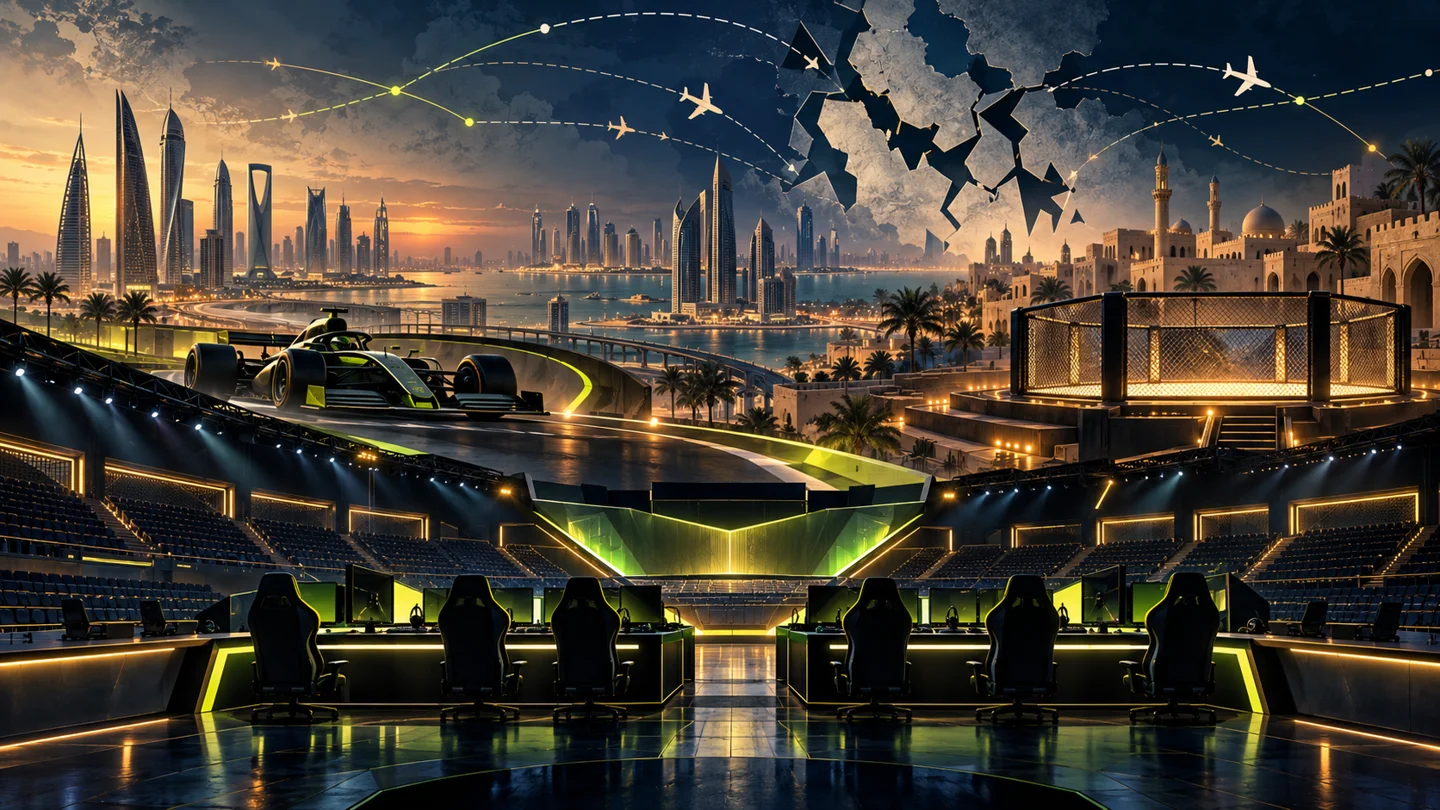
Mghamer · AI-generated conceptual editorial illustration, not a photograph of a real venue or attack.In this article
A gaming tournament can survive the loss of its original venue. A local esports economy may not escape the consequences so easily.
That distinction sits at the heart of the Middle East’s sporting dilemma in 2026. Gulf investment has helped turn competitive gaming into a larger international business. War is testing whether the people, infrastructure and local opportunities around that business can be protected as effectively as its brands.
This is an analysis of documented disruption and the economic mechanisms behind it, checked on 15 October 2026. The conflicts affecting Gaza, Iran and the wider region are not one interchangeable war, and Gulf countries do not face identical conditions. Civilian deaths, displacement and the destruction of daily life are the primary consequences; the sporting consequences examined here are one smaller part of that human reality.
The warning has already reached the tournament calendar
Reuters reported on 15 October that FIFA and the Saudi Esports Federation had postponed the 16–25 October FIFAe Finals in Jeddah following recent attacks, citing regional developments and logistical consequences. This was a developing report at publication. [1]
Earlier, on 20 May, HLTV reported the confirmed relocation of the 2026 Esports World Cup from Riyadh to Paris amid the Iran war. Euronews subsequently covered the competition’s conclusion in Paris in August. These are different outcomes: one event postponed; another delivered in a different country. Neither should be confused with the disappearance of the underlying investment. [2][18]
The distinction matters for a viewer opening a stream. Competition may still happen, the trophy may still be awarded, and the broadcast may still reach another continent. For a local technician, caterer, hotel, Arabic-language production team or first-time event worker, however, a change of host city can mean losing the work attached to that tournament. Continuity for the global brand is not automatically continuity for the original host community.
Saudi Arabia built more than a tournament destination
Saudi Arabia’s expansion is best understood as several connected projects: owning games businesses, operating competition infrastructure, staging international events and developing a domestic industry. Savvy’s 2022 strategy announced SAR142 billion—about US$37.8 billion—in planned investment. Its ambitions included 250 games companies and 39,000 jobs by 2030. Those are announced targets, not a count of completed jobs or audited expenditure. [4]
There is also concrete transaction history. Savvy’s US$4.9 billion acquisition of Scopely closed in July 2023. Scopely later acquired Niantic’s games business in a US$3.5 billion transaction that closed in May 2025. Separately, MTG valued the sale of ESL Gaming to Savvy at US$1.05 billion in 2022; that figure covers ESL, not the entire ESL–FACEIT combination. [5][6][7]
The scale widened again with EA: a PIF, Silver Lake and Affinity Partners consortium announced a transaction at approximately US$55 billion enterprise value, and EA confirmed completion on 4 August 2026. The consortium’s transaction value must not be described as US$55 billion of Saudi government cash, Saudi esports spending, or a domestic development budget. [8][9]
This changes the strategic picture. A country can remain influential through ownership of publishers and tournament companies even when an event moves abroad. But influence through assets and benefits delivered inside the country are separate outcomes. Buying a globally successful business does not, by itself, prove that local junior players, developers or suppliers are building sustainable careers.
The investment ledger: big numbers, different meanings
There is no defensible single total for “everything the Gulf has invested in gaming, esports and sport” in the sources reviewed here. Disclosures cover different years, countries, entities and accounting categories. Some are acquisition values, some are plans, some are prize budgets, and others describe public infrastructure or hoped-for economic output.
The ledger below records selected disclosed or reported figures. It is deliberately not a league table of countries and should not be summed. A subsidiary’s acquisition can sit within a parent’s broader strategy; an enterprise value can include debt; and a GDP target is not an investment cheque.
Selected nominal US-dollar figures. Do not add these rows together.
Entity / period
Figure
What it measures
Saudi Arabia · Savvy strategy (2022)
US$37.8bn / SAR142bn
Announced investment plan; not audited spending. [4]
Saudi-backed acquisition · ESL (2022)
US$1.05bn
ESL enterprise value disclosed by MTG; excludes FACEIT. [7]
Subsidiary acquisition; not a separate national programme. [6]
PIF / Silver Lake / Affinity → EA (2025–26)
About US$55bn
Enterprise value of consortium deal; not PIF cash contribution. [8][9]
Saudi-origin EWC · 2026 edition
US$75m
Announced prize pool; not the full event cost. [10]
Saudi PIF → LIV Golf (reported February 2026)
US$5.3bn
Reported cumulative backing at that date; not an audited Gulf total. [20]
Qatar · World Cup stadiums (2022)
About US$6.5bn
Reported stadium construction cost; excludes broader infrastructure. [12]
UAE · Dubai gaming programme (2033 target)
About US$1bn GDP uplift
Economic-output target, not a disclosed investment budget. [11]
UAE · Abu Dhabi–UFC partnership
Not disclosed in cited announcement
Hosting partnership through 2028; no invented fee. [14]
Bahrain / UAE · McLaren Racing ownership
Not disclosed in cited announcement
Ownership structure; not a comparable expenditure figure. [16]
Why Qatar’s World Cup number needs its own explanation
The often-repeated US$220 billion figure can make it sound as though Qatar paid that amount simply to stage football matches. That is misleading. An IMF study describes a decade-long investment programme estimated at US$200–300 billion, including transport, hotels, ports and airports; stadium construction reportedly cost about US$6.5 billion. Much of the broader programme served national development goals. [12]
That distinction also explains why disruption matters beyond ticket sales. A sporting event is intended to connect existing infrastructure with visitors, hospitality, trade and international visibility. If visitors cannot reach the destination, owning the buildings is not enough to produce the intended activity. Yet it would be equally wrong to write off an airport or railway as a sporting loss because a tournament is interrupted: those assets serve other purposes.
The UAE follows its own mix of policies. Dubai’s gaming programme targets 30,000 new jobs and roughly US$1 billion in additional GDP by 2033. Dubai Future Foundation reported more than 350 gaming-related companies in June 2025. These are a policy target and an ecosystem snapshot—not disclosure of a US$1 billion public investment fund. [11]
Bahrain and Abu Dhabi also illustrate ownership beyond hosting: McLaren’s 2025 announcements describe Mumtalakat and CYVN as its shareholders after changes in the racing business’s ownership structure. The cited disclosures do not supply a comparable purchase price for this ledger. A missing public price is not evidence that an investment was small or nonexistent. [16]
How war reaches esports before the broadcast goes dark
The following is operational analysis, not a claim that every mechanism has occurred at every event. The first pressure point is movement. A competition needs players and coaches, but also referees, observers, producers, interpreters, security staff and technical equipment. If some arrive late, the consequences can spread through rehearsals, practice schedules and match days.
The second is time. Relocation is not just changing an address on a poster. Organizers may need new venue agreements, equipment suppliers, local permissions, travel arrangements and staff availability. Even where the game format survives unchanged, the work needed to stage it does not transfer instantly. Moving early can preserve options; waiting can consume them.
The third is cash flow. A supplier may already have hired people or bought materials when a booking changes. A freelancer may have declined other work. Teams can face revised travel costs while the revenue attached to a tournament remains uncertain. The party with the largest balance sheet is usually better placed to absorb delays than the smallest subcontractor.
The fourth is contractual allocation: who bears rescheduling costs, what insurance actually covers, and what happens to sponsorship deliverables or refunds. Those answers depend on specific contracts and policies. The article does not assume that every interruption is insured or that a generic reference to force majeure settles the bill.
Finally comes competitive fairness. Unequal access to travel, stable practice and adequate rest can become unequal access to performance. A team’s name remaining on a bracket says little about whether its preparation has remained intact. Tournament integrity should therefore include the conditions needed to participate, not only anti-cheat systems and the rules of the match.
Online competition helps—but it cannot solve every interruption
Esports has an option that Formula 1 and UFC do not: some matches can be played remotely. That can protect selected qualifiers or smaller competitions, depending on the publisher’s rules. It does not make a global final interchangeable with an online lobby.
Teams in different locations may face different latency, routing and electricity reliability. Production, competitive supervision and audience experiences also change. A move online can preserve a schedule while changing the conditions under which the result is produced. Sometimes that trade-off is justified; sometimes postponement or relocation offers a fairer competition.
For people living amid destruction, connectivity is also much more than a gaming issue. OCHA documented extensive, recurrent damage to Gaza’s telecommunications infrastructure and serious service disruption in June 2025. That dated evidence should not be mistaken for a live measurement of today’s network. It shows why discussing competition without discussing basic access misses the foundations of participation. [17]
A player who cannot maintain a safe home, regular electricity or contact with family cannot be understood simply as an underperforming competitor. Rebuilding opportunity begins with those needs. No prize pool substitutes for them, and there is no credible dataset in this article that converts lost talent or disrupted childhoods into a dollar value.
Formula 1: the same dependence on movement, at a different scale
Formula 1 confirmed on 14 March 2026 that its Bahrain and Saudi Arabian Grands Prix would not take place in April because of the regional situation. That announcement establishes the disruption to those April rounds. It is not evidence that all Gulf races, or all future editions, were cancelled. [3]
F1 makes the physical nature of global entertainment especially visible. Cars, equipment, staff and broadcast operations must arrive together, and the venue must meet the requirements of the championship. Esports travels more lightly, but its leading events still depend on a dense network of people and services.
The commercial comparison is useful. An investor’s stake in a racing business can remain valuable while a host city loses a particular race weekend. Conversely, staging a spectacular race does not prove that every public investment around it earns a financial return. Ownership returns, hosting economics and national branding should be evaluated separately.
For esports, the lesson is not to copy motorsport’s spending. It is to copy the seriousness with which complex international operations must plan alternatives. A backup venue is useful only if it can be activated in time, if participants can reach it, and if the competition remains legitimate after the move.
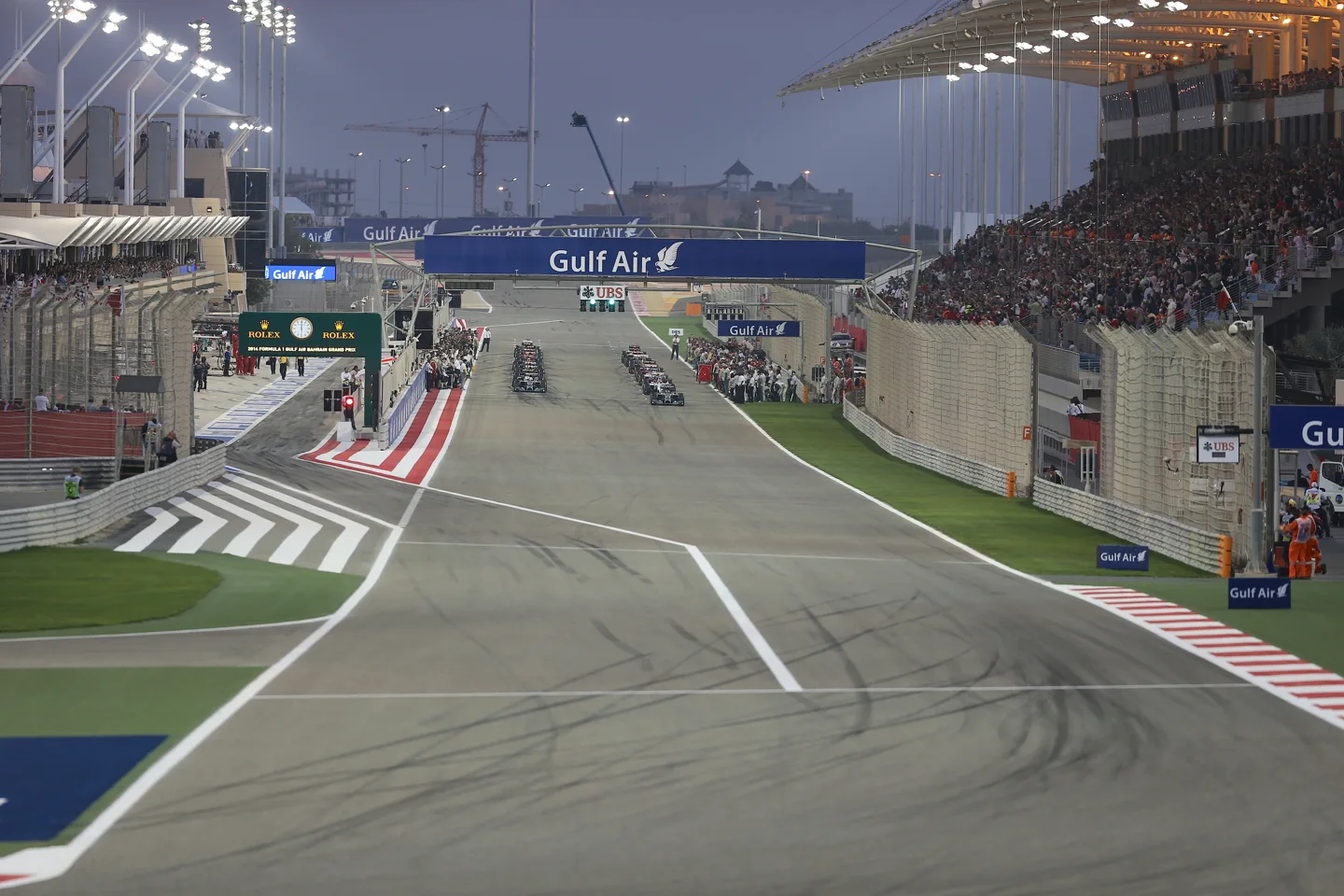
Bahrain Grand Prix starting grid, 6 April 2014. Archive photograph, not the 2026 season. Habeed Hameed · Original image · CC BY-SA 2.0 · Resized and compressed; image licence retained.
UFC: a fight card is also a destination business
Abu Dhabi’s UFC partnership was extended through 2028, with an annual numbered event featuring a championship bout and additional Fight Night events under the expanded arrangement. UFC also established Saudi events, including its return to Riyadh in February 2025. These announcements show the region’s importance to the promotion; they do not disclose a total Gulf UFC investment bill. [14][15]
The Octagon is only the visible centre of the product. Fighters travel with coaches and support teams; organizers need medical, regulatory, production and hospitality arrangements. A disrupted journey can therefore affect a fight card even when the venue remains available. This is an analysis of operational exposure, not a report of a particular UFC cancellation.
For destination marketing, the weekend around the event matters too: hotel nights, restaurants, visitor activity and the city’s appearance on a global broadcast. Relocation may preserve the sporting contest while moving those benefits elsewhere. That is the same distinction the Esports World Cup forces us to confront.
The comparison also exposes a reporting problem. A hosting partnership is not ownership of UFC, and an undisclosed hosting fee should not be replaced with a rumoured number simply to make an investment table look complete.
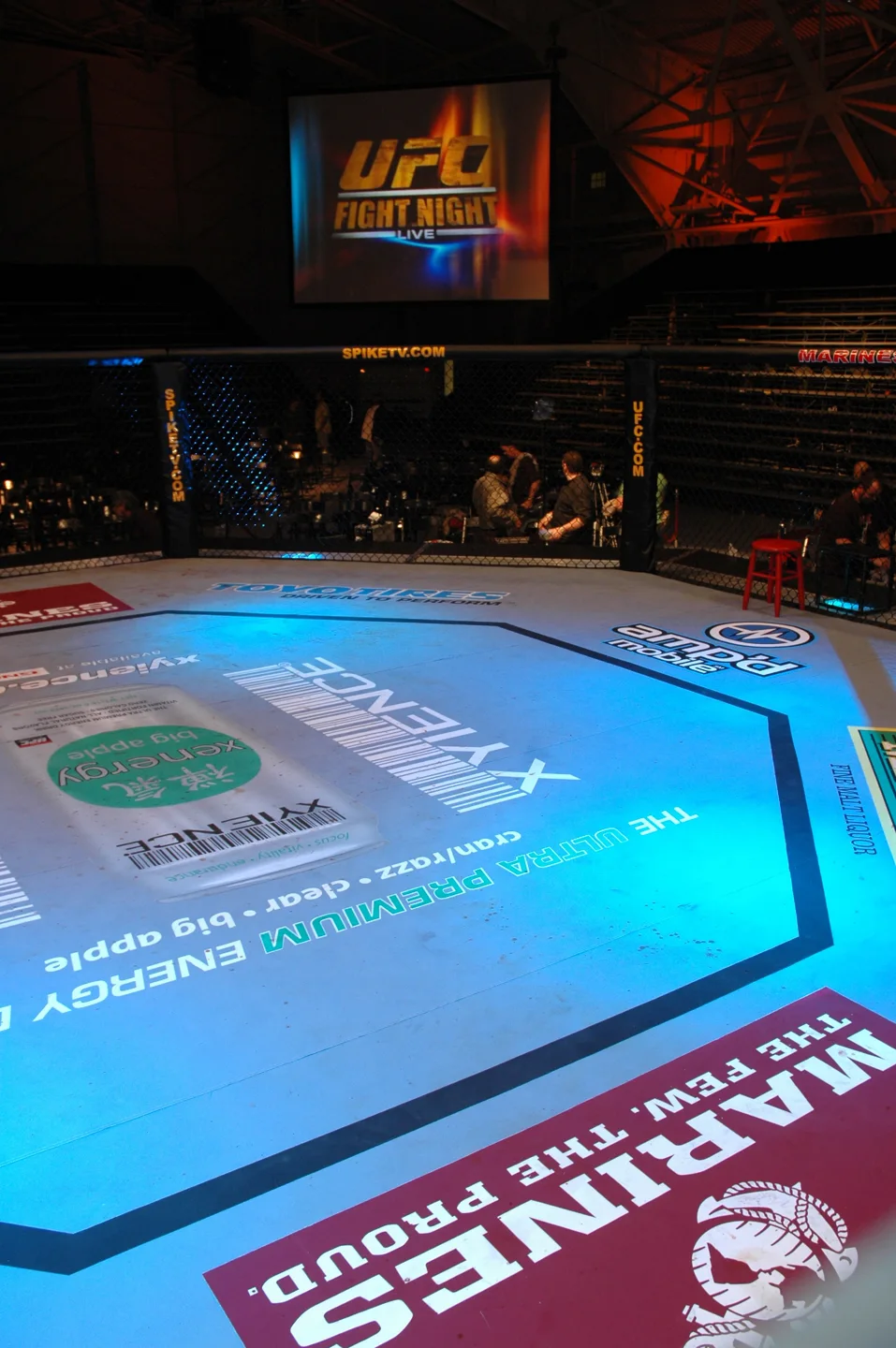
The Octagon at UFC Ultimate Fight Night 7 in the United States, December 2006. Archive image; not a Gulf event. Sgt. Leonard Langston / USMC · Original image · Public domain (US government work) · Resized and compressed; image licence retained.
The deeper risk: depending on a few big payers
Long-term capital can help an industry fund tournaments, develop infrastructure and survive weak commercial years. But concentration creates exposure. If a club, supplier or organizer depends heavily on a small number of events or funders, a change in those programmes can affect several revenue streams at once.
Golf provides a relevant caution without proving a direct war effect. AP reported in April 2026 that PIF would end LIV Golf funding beyond that season, after investing more than US$5.3 billion. That is a reported funding decision, not evidence that war alone caused it or that esports will follow the same path. [13]
The implication for esports is a question rather than a prediction: how much of the ecosystem can continue when a major funder changes priorities? Merchandise, subscriptions, commercial partnerships, local participation and publisher support are different potential revenue sources; none is automatically sufficient. Diversification must be demonstrated in accounts, not merely listed in a presentation.
War adds uncertainty to that existing business problem. It can increase operating costs and complicate planning. It can also coincide with changes in public spending priorities. Higher energy prices do not automatically translate into more money for sport: production volumes, export access, other obligations and investment decisions also matter. A confident claim that conflict inevitably enriches or bankrupts every Gulf sports project would be too simple.
Growth, reputation and the question of who benefits
The Saudi expansion has created a genuine debate about economic development, political influence and human rights. Le Monde’s reporting on the Paris EWC partnership described criticism of Saudi “esportswashing” alongside extensive cooperation with the French esports sector. That criticism should be attributed, not presented as an explanation for every participant’s motives. [19]
Local fans can sincerely love games while states pursue international influence through them. A player accepting an opportunity, a young developer seeking work and a government financing a tournament are not interchangeable actors. An honest assessment needs room for real professional opportunities and scrutiny of the institutions funding them.
The strongest test of development is what remains between headline events. Are there sustainable local jobs, paid apprenticeships, independent studios and accessible competitions? Are suppliers paid reliably? Can talented players progress without relying on one invitation? Are women and people with limited financial resources able to participate? These are evaluation questions, not claims that every programme has succeeded or failed.
Counting prize money alone cannot answer them. Nor can counting acquisitions abroad. Both can be part of a development strategy, but the link to lasting opportunity at home needs evidence.
What a more resilient regional esports industry would do
For organizers, resilience means setting decision deadlines before circumstances remove the available alternatives. It means keeping participants informed, testing substitute production arrangements, checking realistic travel routes and setting out how postponement affects pay and refunds. Safety decisions should not depend on whether a player can afford to lose an appearance.
For teams, it means knowing their financial exposure to each event, keeping essential documents current and avoiding a season plan that collapses when one booking disappears. For publishers, it means explaining in advance when remote play, replacement qualifiers or venue changes can be authorized—and what safeguards preserve fairness.
For public investors, it means measuring more than spectators and announcements. Local supplier spending, durable employment, skills retained in the country, repeat visitors and the survival of small firms are more revealing than a single headline investment figure. A transparent distinction between commercial return and public-policy objectives would also make those programmes easier to assess fairly.
For regional media, it means resisting two tempting stories: that money makes an event immune to war, or that one disruption proves the entire project worthless. Both flatten a complicated reality. The more important reporting follows the people and obligations that remain after the headline changes.
The future depends on who can stay in the game
The Gulf has acquired enough influence that disruption to its events is now a global sporting issue. That is evidence of how far its strategy has travelled. It is also a responsibility: the stronger its place in the calendar, the more people elsewhere depend on its decisions.
The most revealing image of this moment is not the largest trophy or the most expensive acquisition. It is the difference between a tournament that can move and a community that cannot. Global brands may find another venue. Young competitors, local suppliers and freelance crews need a future where participation does not disappear with the booking.
A successful recovery should therefore be judged by more than the return of the opening ceremony. It should be judged by whether the industry has become better at protecting people, distributing opportunity and sustaining competition when conditions become difficult.
Reporting and methodology
Prepared with AI assistance from the linked public sources; this feature includes original analysis, not firsthand interviews or an independently audited spending database. Event reporting was checked on 15 October 2026. Financial figures retain their announcement dates and categories; historical numbers are not presented as a current aggregate. Figures in the ledger overlap and must not be added together. No unpublished Mghamer interview material was used. The cover is a generated editorial illustration; archive photographs carry their own dates and credits.
There was no single inventor or starting gun. From early arcade sounds and Koji Kondo’s memorable themes to Imagine Dragons at Worlds and Riot’s virtual pop group K/DA, music has become a way for games and esports to build emotion, identity and community.