League of Legends Beginner Guide: Learn the Map Before the Meta
5 min read
Part of the beginner collection — explore all 10 guides ↗
MAKE IT YOUR READSaved
A practical first week in League: choose a role, manage your lane, prepare objectives and learn from mistakes without buying shortcuts.
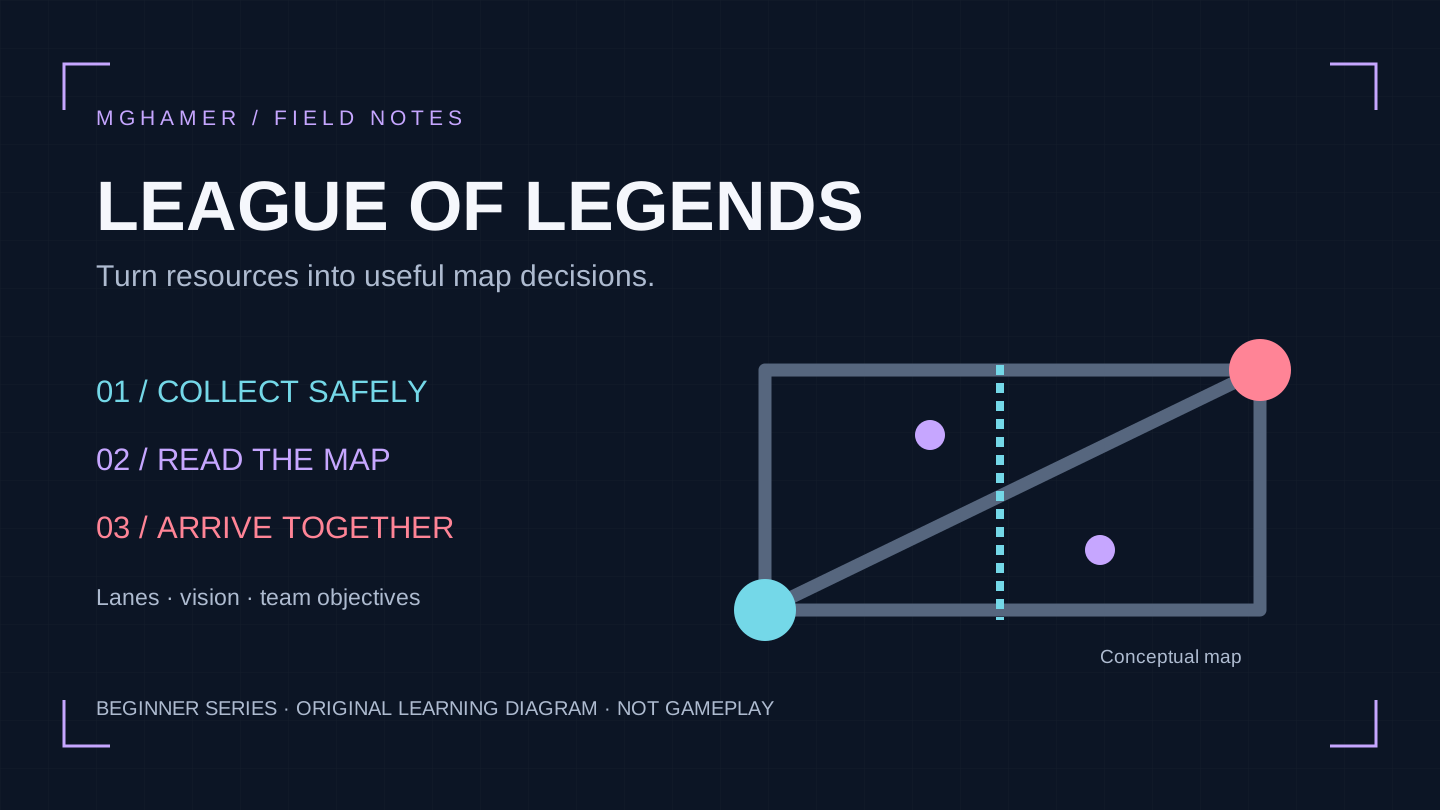
League of Legends can look like a test of how many champion names you remember. Your first week should be a test of something smaller: can you recognise a safe moment to collect resources, a dangerous moment to walk forward and a useful moment to help your team? Those decisions matter long before you understand every matchup.
This guide covers the PC game's Summoner's Rift rather than Wild Rift. Its practice routine is Mghamer's suggested approach, not a publisher curriculum or a promise of rank. You can work through it without buying champions, cosmetics or coaching: use suitable choices already available to your account.
Know what wins and choose one position
Two teams of five aim to destroy the opposing Nexus. Lanes contain defensive structures, while the jungle contains neutral objectives. Gold buys items and experience develops your champion. Riot's official introduction identifies five positions: top, jungle, mid, bot and support. A kill can create an opportunity, but does not replace the task of reaching and destroying the base.
Choose one position to investigate first and a backup for when it is unavailable. Read the abilities of a champion you can access. For contrast, Riot labels Garen a fighter/tank and Lux a mage/support; these are examples of different kits, not claims that either is the strongest current pick. Select for understandable decisions rather than a fashionable win-rate headline.
Set up a learning environment
Complete the available introductory experience and use a practice or beginner-friendly mode to test movement, targeting and the shop. Read tooltips instead of trying to memorise a full build from a video. Find your camera controls and pings before entering a match where you will need both under pressure.
MENA is not one connection profile. Before creating or transferring an account for a supposed latency advantage, check the regions currently offered, where friends play and the actual service conditions. Compare stability at your usual play time. This guide does not prescribe a universal best server or guarantee that changing region will improve your experience.
Give yourself one job for the session. For a lane learner, that could be tracking the next safe opportunity to collect a minion. For a support learner, it might be noticing when a partner needs room to retreat. The point is to build an observation habit you can describe after the game.
Turn the first lane into a resource lesson
If you are playing a farming role, practise timing the final hit on minions in a low-pressure setting. Notice when an attempt would require walking into obvious danger. Record both missed opportunities and unnecessary risks; a larger count is not a success if achieving it repeatedly gets you killed. Support has different resource responsibilities, so do not copy a farming exercise blindly into that position.
Before using an ability on the wave, ask what you want the lane to look like afterwards. Before returning to base, consider your health, resources, available purchase and what your opponent can do while you are away. Read the current recommended items as a starting point, then read what an item actually does. Avoid treating a saved build as an instruction that overrides the match.
Use the minimap as a repeated question: who is visible, who is missing and where is my nearest help? Practise checking it after an ordinary action, rather than only when danger has already arrived. If you cannot account for several opponents, your next forward step deserves more caution.
Prepare objectives instead of arriving late
When teammates want to contest a neutral objective, consider the route before the fight. Can you arrive together? Do you know what is in the river? Are you carrying resources you should have spent earlier? Walking alone into an unknown area to place vision is not automatically helpful just because vision matters.
After a favourable fight, ask which safe action converts the advantage: pressure a structure, collect resources, prepare the next objective or return to base. Avoid wandering between all four until none remains available. Use pings and short plans, and leave arguments about blame outside the next decision.
Three mistakes and a seven-day reset
First, learning a new champion every match until every death feels mysterious. Repeat a small pool. Second, following an opponent into an unobserved area because they look vulnerable. Check who else could be there. Third, saving your review for the final defeat screen. Write down one earlier choice while you still remember the situation.
Day one: explore controls and one champion's abilities. Day two: practise resource collection or your support responsibilities without chasing fights. Day three: review three avoidable deaths and identify missing information. Day four: make a deliberate return-to-base plan in each match you play.
Day five: focus on arriving with teammates for an objective rather than arriving first alone. Day six: review one win and ask which decisions were repeatable, not merely lucky. Day seven: repeat your initial exercise and choose one habit for next week. Keep breaks and a realistic session limit. Learning to explain one good decision is a better foundation than trying to understand the entire game overnight.
Sources & further reading
- Riot Games — How to play League of Legendsleagueoflegends.com
- Riot Games — Garen abilities and roleleagueoflegends.com
- Riot Games — Lux abilities and roleleagueoflegends.com
What did you take away?
Real reactions. Thoughtful discussion. Every comment is reviewed before it appears.
Loading reader contributions…
Sign in to join the discussion