TFT’s history, Mortdog, the Sets and what comes next
5 min read
A deep look at seven years of Teamfight Tactics: the set model, Mortdog’s design legacy, the game’s hits and stumbles, esports and the Unreal-era future.
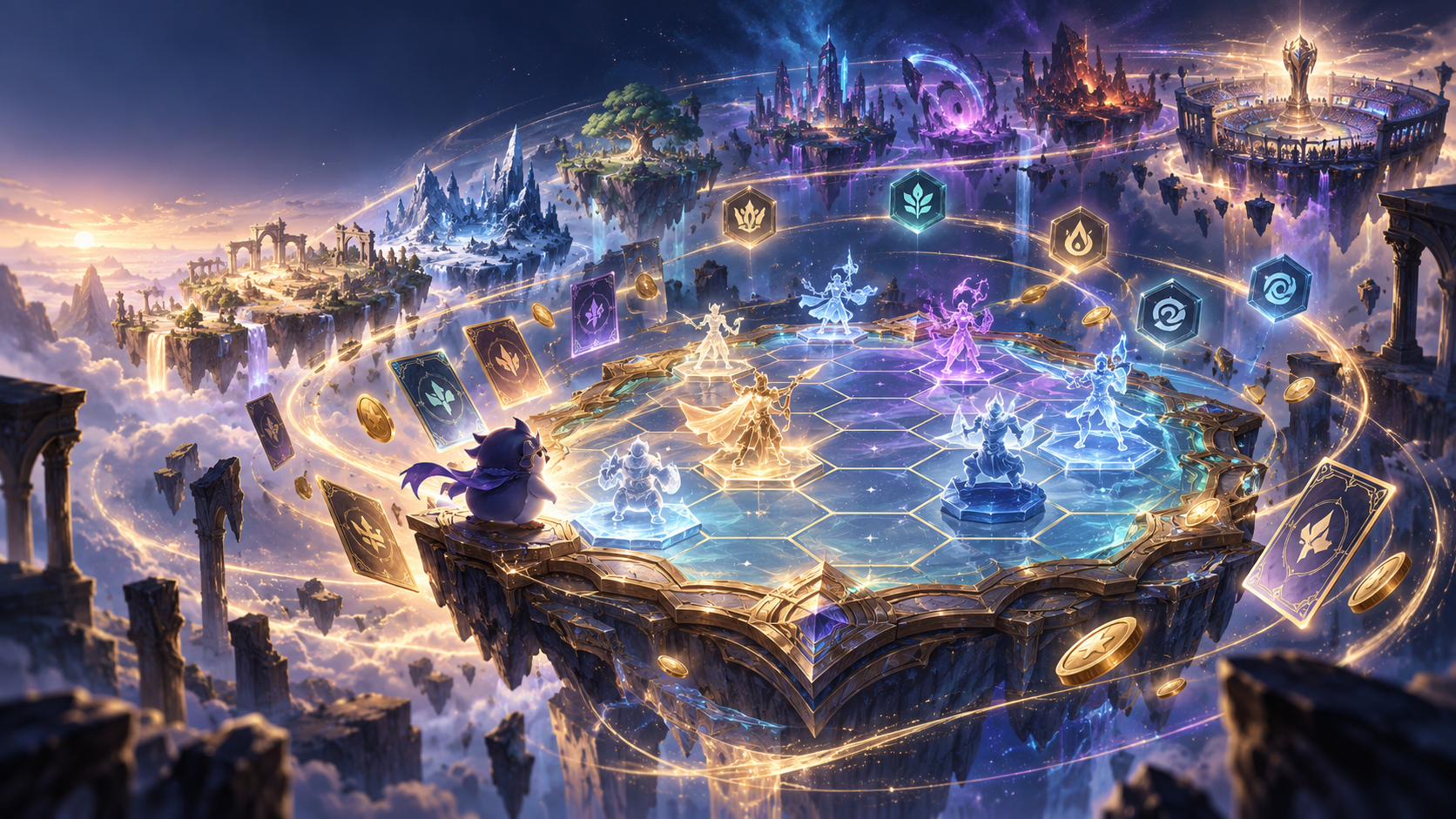
Seven years ago, Teamfight Tactics was Riot’s fast answer to the Dota Auto Chess moment: eight players, a shared shop, economy, League champions and automated combat on a hex board. The idea that began with 50 champions in 2019 has become a seasonal strategy game built around one difficult question: how do you make a game with luck deep enough to reward decisions?
From launch mode to seasonal game
Set 1 established the economic and board fundamentals. Rise of the Elements introduced environmental variety; Galaxies paired match-to-match rules with TFT’s mobile arrival. Fates, Reckoning, Gizmos & Gadgets, Dragonlands and Monsters Attack! then expanded the design vocabulary through chosen champions, morality themes, Augments, huge units and Hero Augments.
The modern era became more deliberate about identity: Runeterra Reforged, Remix Rumble, Inkborn Fables, Magic n’ Mayhem and Into the Arcane each married a theme to a central decision system. Into the Arcane used the Anomaly and Team-Up Augments around Arcane’s cultural moment. In August 2026, Enchanted Wilds opened another chapter: TFT moved to Unreal Engine.
Mortdog: a face of the game, not its only author
Stephen “Mortdog” Mortimer was named Riot’s Game Design Director in the Lore & Legends retrospective and, for years, became the person most visibly explaining TFT to its audience. That does not mean one person makes a Set. TFT is made by set leads, live-balance designers, producers, artists, engineers, analysts and QA. Mort’s contribution was also communicative: patch rundowns, direct discussion and a willingness to explain trade-offs.
The community phrase “Mortdogged” captures TFT’s central tension. It turns bad shop rolls into a joke about one designer, but really describes the balance between RNG and skill. Good TFT design does not eliminate luck. It gives players enough agency to turn poor luck into a survivable game, and good luck into a win that is not thrown away.
How a Set is made
Riot’s Game Analysis Team describes a process of validating units, traits and Augments before they are playable, then simulating representative late-game boards and testing data against gameplay. Its stated standards include clear, satisfying combat; viable vertical and horizontal traits; and scouting that matters without deciding everything.
The major structural change was retiring large mid-sets in favour of three longer Sets per year. Riot’s reasoning was candid: a mid-set could create a burst of novelty, but also asked players to relearn half the game and constrained development. Longer cycles give one defining mechanic more testing time.
Best and worst Sets: the honest way to rank them
Riot does not publish a complete audited table of active-player counts by Set, nor a single comparable viewership series for every event. It would therefore be misleading to declare one Set the largest or smallest by player count as a documented fact. The useful lens is three separate measures: play participation, community sentiment and competitive health.
By community reputation, Gizmos & Gadgets (Set 6) remains a perennial favourite because Augments made experimentation feel broad. Remix Rumble (Set 10) showed how a cohesive theme can serve the game: Headliners and music made compositions feel like performances. Into the Arcane (Set 13) capitalised on Arcane but was not cosmetic-only; its Anomaly and Team-Up systems created permanent and combinatorial choices. Lore & Legends (Set 16) is significant for pursuing depth through unlockable units rather than simply adding another overlay.
The rougher chapters are not total failures. Dragonlands exposed the danger of massive units becoming compulsory. Parts of Reckoning and its mid-set drew fatigue and volatility criticism. K.O. Coliseum sparked balance debate around its central system. The lesson is that a Set packed with ideas is not automatically the best competitive environment.
TFT as esports
TFT competition is not a smaller version of League. It is an eight-player lobby with changing shops, items and opponents, so the strongest formats reward consistency over several games. The 2026 Space Gods Tactician’s Crown featured 40 players from AMER, EMEA, APAC and CN, scoring each game from eight points for first down to one for eighth. That rewards adaptation, lobby reading and damage control.
The spectator challenge is different too: newcomers need a fast explanation, while experienced players want to read economy, Augments and positioning. Live events such as the Vegas Open are important because they make a knowledge-heavy game feel like an occasion.
What comes next
The biggest bet is technical, not a new trait. Riot moved TFT to Unreal to build TFT-specific tools, reduce dependence on League’s shared engine and better align PC and mobile development. Riot has also acknowledged that Enchanted Wilds launched with performance, crash, input and cosmetic-parity problems, and created Follow the Fix to track the work.
If the transition pays off, its value will be gradual: a dedicated client, better tools, bolder mechanics and more room for Set Revivals and lighter modes without compromising the core game. TFT’s history suggests growth does not come from adding complexity every time. It comes from a legible decision, repairable balance, a theme players want to return to and competition viewers can understand.
Bottom line
TFT survives because each Set is a testable hypothesis, not a sealed product. Mortdog became a symbol of that public learning process, but the strength is a team that revises its ideas openly. The best Sets turn a loss into a lesson and a win into the consequence of a decision; the weakest hide decisions behind noise. TFT’s future will depend less on how many traits it can add than on whether Unreal gives that philosophy more room to work.
Sources & further reading
- https://teamfighttactics.leagueoflegends.com/en-au/news/dev/dev-design-pillars-of-tft/teamfighttactics.leagueoflegends.com
- https://teamfighttactics.leagueoflegends.com/en-us/news/dev/talking-tactics-game-analysis-team-gat/teamfighttactics.leagueoflegends.com
- https://teamfighttactics.leagueoflegends.com/en-sg/news/dev/talking-tactics-reflecting-on-the-end-of-mid-sets/teamfighttactics.leagueoflegends.com
- https://teamfighttactics.leagueoflegends.com/en-us/news/game-updates/into-the-arcane-overview/teamfighttactics.leagueoflegends.com
- https://teamfighttactics.leagueoflegends.com/en-ph/news/dev/dev-tft-lore-legends-reviewed/teamfighttactics.leagueoflegends.com
- https://teamfighttactics.leagueoflegends.com/en-us/news/esports/tft-space-gods-tacticians-crown-announcement/teamfighttactics.leagueoflegends.com
- https://teamfighttactics.leagueoflegends.com/en-au/news/game-updates/faq-tft-unreal-migration/teamfighttactics.leagueoflegends.com
- https://teamfighttactics.leagueoflegends.com/en-us/news/dev/tldw-follow-the-fix-update/teamfighttactics.leagueoflegends.com
What did you take away?
Real reactions. Thoughtful discussion. Every comment is reviewed before it appears.
Loading reader contributions…
Sign in to join the discussion