VALORANT Beginner Guide: Build a Round Plan Before Chasing Kills
5 min read
Part of the beginner collection — explore all 10 guides ↗
MAKE IT YOUR READSaved
Understand agents, team economy and Spike decisions, then practise with a focused seven-day plan for MENA players.
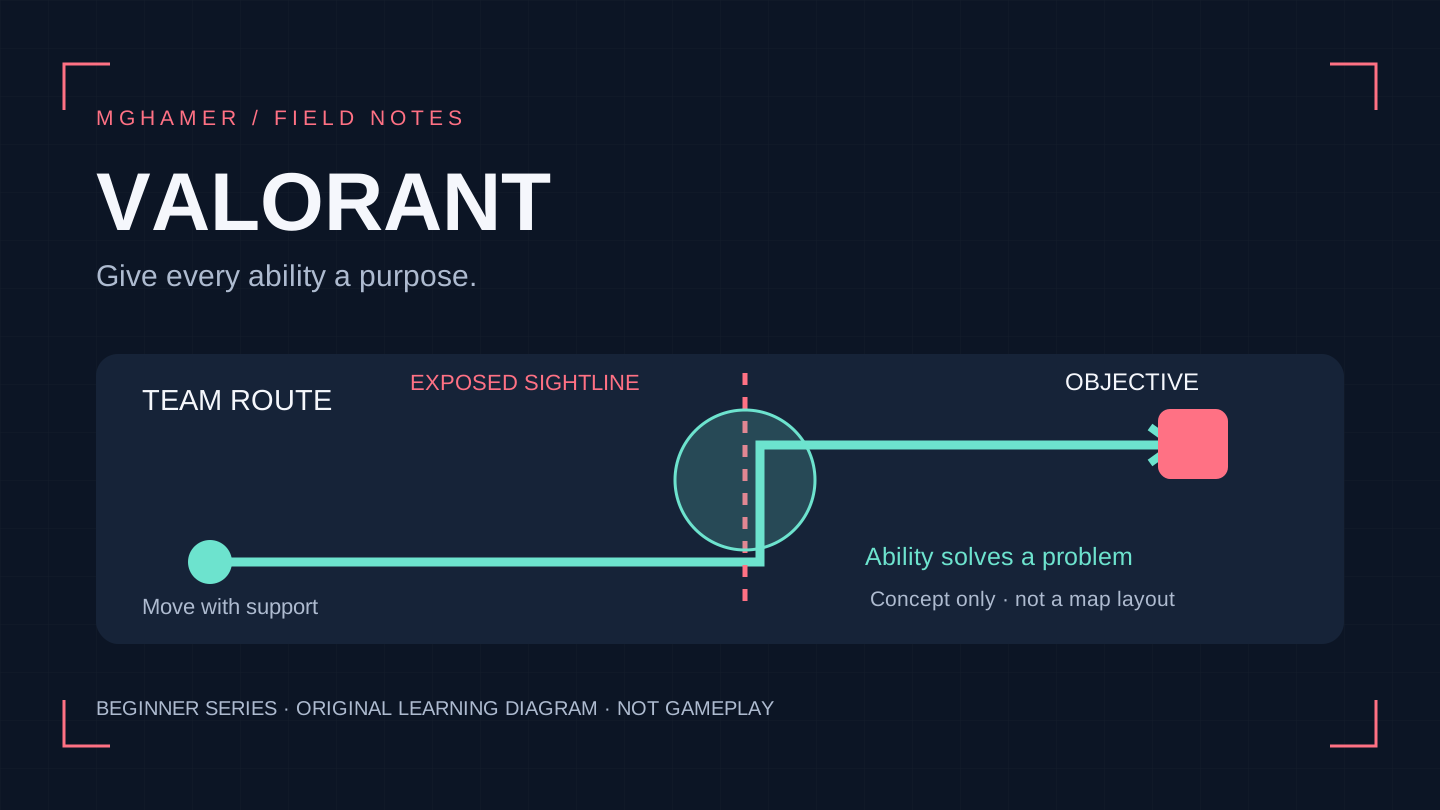
VALORANT becomes easier to read when you stop asking only “Where can I get a kill?” and start asking “What does my team need next?” Sometimes the answer is an entry. Sometimes it is a smoke, a patient hold or simply bringing the Spike safely to the site. A beginner can contribute to that sequence before winning every duel.
This is a practical PC starting plan, not a tier list. The drills are Mghamer's editorial suggestions, and progression depends on practice and circumstances. You do not need to purchase cosmetics or immediately unlock a fashionable agent to use them.
Learn the objective, then choose a job
In the standard attack-and-defence format, attackers try to plant and detonate the Spike; defenders prevent the plant or defuse it. Credits fund weapons, shields and purchasable abilities. Riot's beginner guide explains these foundations. Do not treat a planted Spike as a signal to wander off looking for opponents.
Choose an available agent whose ability descriptions you can understand. Riot groups agents into roles; use the official agent pages to inspect the actual kit rather than assuming every character in a role behaves identically. For your first sessions, write one useful job in plain language: “I help us cross this sightline” or “I watch this approach while teammates move.”
Test your setup in your actual region
Pick readable graphics and a sensitivity that lets you make controlled adjustments. Leave those settings stable long enough to learn from them. In the practice area, test moving, stopping and firing separately before combining them. If your hand feels tense, pause rather than forcing a longer session.
Riot's Server Select documentation says solo players and party leaders can choose among servers available in their region; this does not change the account's shard. Bahrain appears in its listed European-region options. That does not make it the right choice for every MENA household. Compare the servers actually offered to your account using latency and stability at your normal play time, including your friends' connections when grouping.
Start in a non-ranked mode you have time to finish. Tell teammates you are learning and use pings if voice is unavailable or uncomfortable. Practise one concise call: location, what you saw and what you intend to do next. Mute harassment rather than trying to win an argument during the round.
Spend and use abilities with a purpose
Before buying, look at your teammates' money and agree whether the round is a full purchase, a limited investment or a save. Do not leave the team alternating between one rich player and four under-equipped ones. Read the menu's current prices and next-round information; this guide deliberately avoids a patch-dependent shopping formula.
Choose an ability because it solves an immediate problem. Before throwing something through a doorway, ask whether a teammate is about to enter it. Before blocking a sightline, ask whether the obstruction also removes information your team needs. A simple ability you understand is more valuable to your learning than an elaborate setup copied without context.
After planting, identify where teammates can support each other. If defending a planted site, first locate available cover and the teammate you can coordinate with. These questions create a round plan: where will contact happen, who responds, and who deals with the objective? They also explain why a low-kill round can still be useful.
Three mistakes that make learning slower
First, changing agents and settings after every loss. Keep one main learning choice and one backup so you can compare similar situations. Second, using all your abilities at the start merely because they are available. Practise explaining what each use achieved. Third, moving into a second angle before resolving the first. Walk through an empty route and identify how many places can see you at each stop.
When reviewing a death, look earlier than the final shot. Did you know a teammate had stopped following? Did your ability leave your hands at the wrong moment? Did you take a fight that had no connection to the Spike? Choose one answer to practise rather than declaring that everything was bad.
Seven days of deliberate practice
Day one: learn your controls and read one agent's complete kit. Day two: rehearse movement and controlled shots for ten minutes. Day three: explore a map and name three places where you need help crossing. Day four: practise an ability with a friend and ask what they could see or do because of it.
Day five: coordinate purchases and record one decision that helped the following round. Day six: review three deaths and separate positioning, timing and execution errors. Day seven: play a manageable session focused on your most common error, then compare your notes. The useful reward is a clearer explanation of your choices, not a guaranteed rank by Sunday.
Sources & further reading
- Riot Games — VALORANT beginner guideplayvalorant.com
- Riot Games — Agent directoryplayvalorant.com
- Riot Support — Server Selectsupport.riotgames.com
What did you take away?
Real reactions. Thoughtful discussion. Every comment is reviewed before it appears.
Loading reader contributions…
Sign in to join the discussion