Automated narration using browser voices. Quality and availability vary by device; your voice provider may use an online service.
Tencent and Riot, Valve, Xbox, PlayStation, Nintendo, Epic and Savvy influence gaming in different ways. Here is where their power comes from.
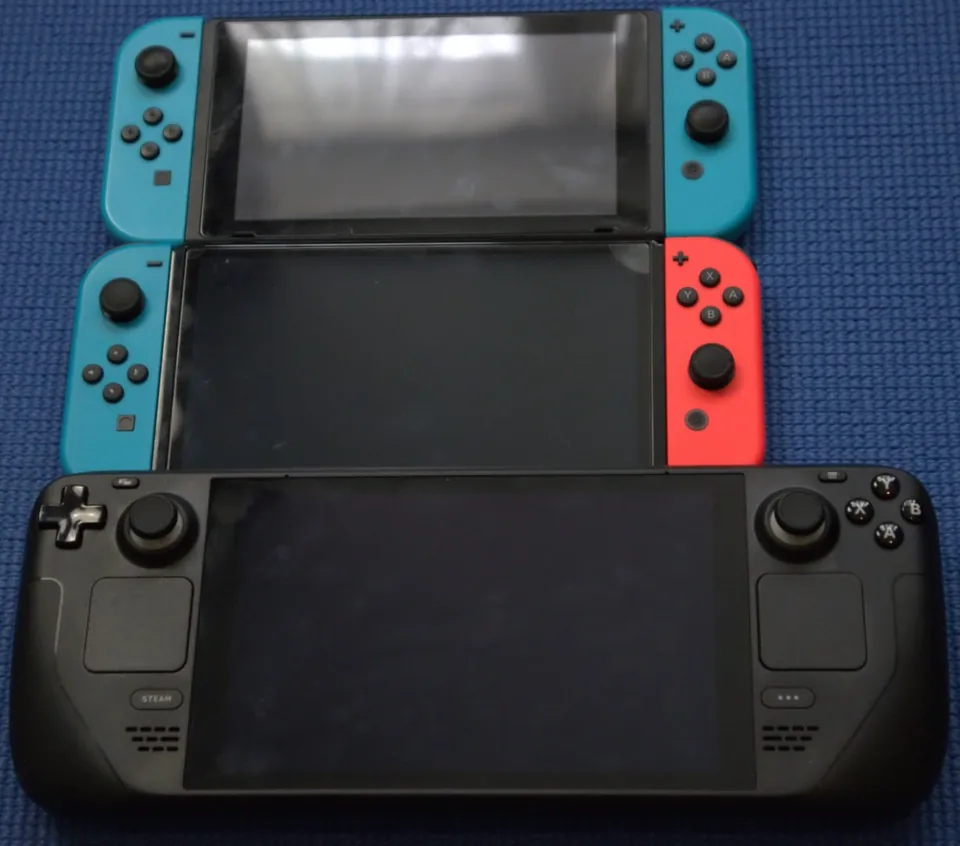
Nintendo Switch, Switch OLED and Steam Deck, photographed in 2022: different approaches to gaming hardware. Liam Dawe/GamingOnLinux · Original image · CC BY-SA 4.0 · Resized and compressed for publication.In this article
The most influential company in gaming is not necessarily the one with this month’s best-selling release. Some businesses own the games; others control the storefront, subscription, creation tools or investment that gets a project made. To understand who moves the industry, follow those decisions as closely as the launch trailers.
This is Mghamer’s editorial selection of seven influential companies or groups, not a ranking by market value or a complete list of the world’s biggest publishers. The figures below use their stated reporting periods; different currencies and business models make a simple league table misleading.
Tencent and Riot: the games and the competitive ecosystem
Tencent announced its majority investment in Riot Games in 2011. Riot’s League of Legends and VALORANT place it at the centre of two major competitive communities, where changes to the game and its esports structure affect players, clubs and viewers together.
The power to watch here is rule-setting: which competitions exist, how teams participate, and how the experience keeps fans engaged. Our view is that ownership of a competitive game gives a publisher influence that a tournament sponsor alone cannot buy.
Microsoft and Xbox: a business beyond one console
Microsoft’s FY2025 annual report recorded $23.455 billion in gaming revenue for the year ended June 30, 2025. Its gaming strategy spans content, subscriptions and multiple ways to play, including console, PC and cloud.
The consequential decisions concern access: where a game launches, how it is sold, and whether players buy it separately or through a subscription. For readers, the useful question is how those choices change the value of a library over time. This historical revenue figure is a scale reference, not a 2026 forecast.
Sony and PlayStation: the value of the platform
Sony reported ¥4,685.7 billion in Game & Network Services sales and ¥463.3 billion in operating income for FY2025, ended March 2026. The distinction matters: sales and operating profit describe different parts of the same business.
PlayStation’s influence includes its platform and network services, not just individual game releases. Watch how its software and service choices compete for a player’s ongoing spending. We retain Sony’s reported yen figures rather than manufacture a dollar ranking using a different exchange rate or reporting period.
Nintendo: hardware with a distinctive reason to buy
Nintendo’s May 2026 results briefing reported 19.86 million Switch 2 hardware units sold through the end of March 2026. That is a hardware-sales measure, not an esports audience or a count of active players.
Nintendo illustrates another route to influence: giving customers a compelling reason to choose a particular device and its games. For competing publishers and developers, a growing platform creates decisions about development resources, release timing and which audiences to prioritise.
Valve and Steam: the route to PC players
Steam combines a games storefront with community features and development and publishing tools through Steamworks. That makes Valve relevant to far more than the success of any one release: developers also need their games to be discovered, purchased and supported.
Our assessment is that distribution is one of gaming’s least visible forms of power. Store visibility and the player’s existing library can influence where attention goes. This article does not assign Valve an annual revenue figure or a valuation it has not verified.
Epic: creators inside the platform
Epic’s Fortnite engagement-payout documentation describes a system that allocates 40% of eligible net revenue to an engagement pool shared among eligible island publishers, including Epic. It is not a promise that every creator receives 40% of their island’s sales.
The broader significance is the role of creators as developers inside an existing game. Discovery and payout rules can affect whether a small team finds an audience and earns enough to continue. Building a strong experience and building a dependable business remain separate challenges.
Savvy, Scopely and ESL FACEIT Group: capital across gaming and esports
PIF’s portfolio information places Scopely and ESL FACEIT Group under Savvy Games Group. Scopely’s $3.5 billion acquisition of Niantic’s games business, including Pokémon GO, was completed in May 2025, according to the companies’ announcements.
For MENA readers, this is a direct connection between regional capital and global gaming businesses. Mobile games and esports operations provide different kinds of reach. The important follow-up is what investment delivers: durable products, opportunities for talent and commercial relationships that survive beyond a launch announcement.
The decisions worth following next
A useful industry watchlist has more than acquisitions on it. Follow distribution terms, subscription changes, creator economics, tournament policies and the support available to developers. These decisions influence what reaches your screen—and who can afford to keep making it.
Sources reviewed October 6, 2026. Selection and interpretation are Mghamer’s analysis; company-reported metrics are identified by period and are not directly comparable.
There was no single inventor or starting gun. From early arcade sounds and Koji Kondo’s memorable themes to Imagine Dragons at Worlds and Riot’s virtual pop group K/DA, music has become a way for games and esports to build emotion, identity and community.
A deep look at seven years of Teamfight Tactics: the set model, Mortdog’s design legacy, the game’s hits and stumbles, esports and the Unreal-era future.