Automated narration using browser voices. Quality and availability vary by device; your voice provider may use an online service.
From Vitality’s 2018 debut to Paris and the 2025 Majors: a deep look at ZywOo’s weapons, decision-making, teammates and defining tests.
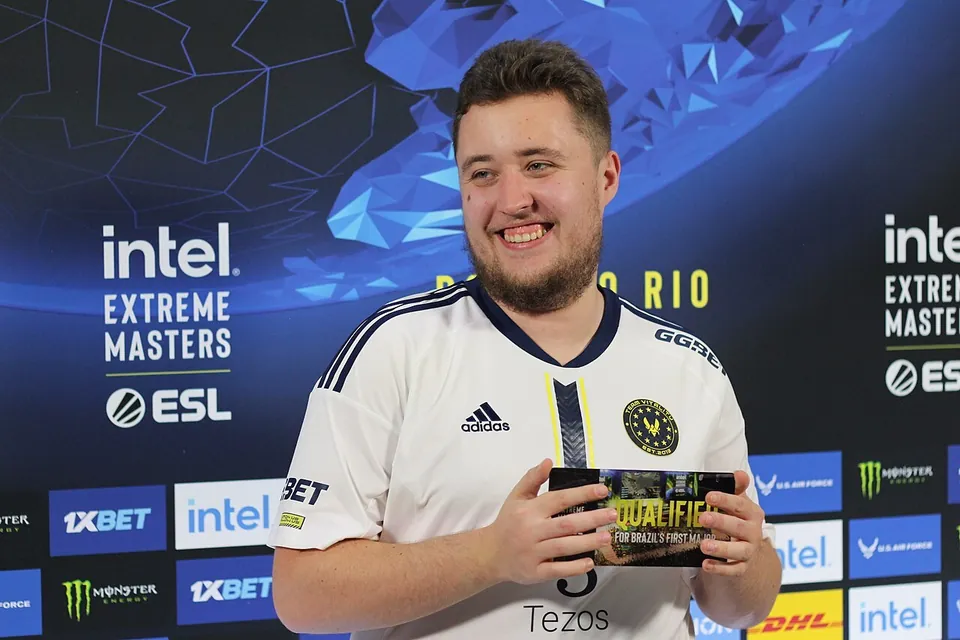
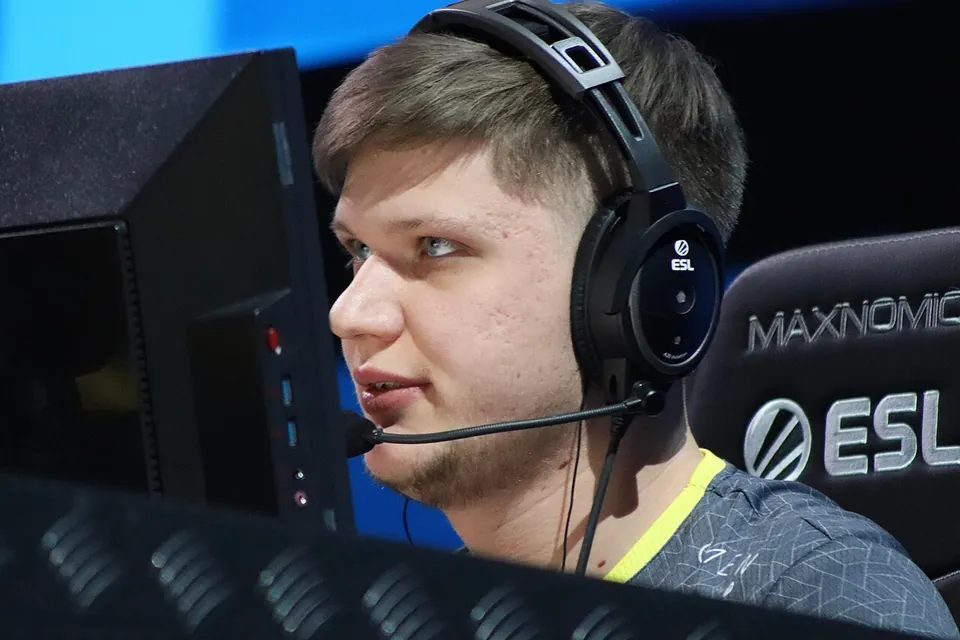
ZywOo at the IEM Rio European RMR, October 2022. Archive photograph, resized. VaKarM.net · Original image · CC BY 2.0 · Resized and compressed for publication.In this article
The most revealing ZywOo moment is not always the shot that makes the crowd stand up. Sometimes it is the step backwards immediately afterwards: the decision to preserve an advantage, change the next opponent’s angle and keep an expensive weapon alive. Spectators remember the flick. Teams have to survive everything that happens around it.
Mathieu “ZywOo” Herbaut’s career asks a difficult question about Counter-Strike greatness. What if extraordinary talent is expressed through decisions that make extraordinary situations less necessary? The French star can produce outrageous highlights, but a compilation alone cannot explain why he has remained so valuable across different Vitality lineups and both CS:GO and CS2.
This profile examines selected career milestones through the end of 2025, alongside Mghamer’s tactical interpretation. The historical ranking graphic is an annual award record, not a live 2026 form table. We distinguish documented results from analysis: no invented tracking data, private team communications or claims to know what a player was thinking.
The arrival: a prospect becomes the centre of a project
Vitality announced its first Counter-Strike roster in October 2018, bringing ZywOo into a French lineup with established professionals. That starting point matters. This was not an already decorated international superstar choosing the strongest available team; it was a major organisation making an exceptional prospect central to its competitive future.
By the end of 2019, HLTV had ranked him the world’s best player in his first full professional year. Recognition arrived before a long trophy collection could make his reputation feel inevitable. The interesting question shifted rapidly from whether he could compete at the highest level to how a team could turn his individual output into durable championship contention.
A breakthrough like that creates two jobs. The player must keep solving opponents who now prepare specifically for him. The organisation must resist treating talent as a substitute for roster construction. A star can rescue a poor situation; asking him to rescue every poor situation is not a sustainable system. ZywOo’s subsequent career is compelling partly because it contains both individual recognition and the slower work of assembling winning teams.
Consistency is a record, not a personality trait
HLTV’s completed annual lists placed ZywOo first in 2019, 2020, 2023 and 2025, second in 2021 and 2022, and third in 2024. Seven consecutive top-three finishes are a more useful starting point than a vague claim that he “never has a bad game.” He does have difficult games; the record describes the strength of entire seasons.
The distinction matters because an annual placement is not a raw aim measurement. It combines performance with the competitive context available to the award’s selectors. Our graphic therefore displays positions, not fabricated percentages of greatness. It also stops at 2025: an unfinished season cannot be assigned a final annual award.
Do not infer an internal emotional state from his public demeanour either. A quiet reaction on camera does not prove an absence of pressure, just as an expressive reaction does not prove poor discipline. The defensible claim concerns repeated competitive output. The explanation requires looking at decisions, teammates and the circumstances in which those numbers were produced.
MGHAMER / CAREER FILE 01
Seven seasons in the top three
ZywOo’s annual HLTV placements • 2019–2025
2019
#1
No. 1
2020
#1
No. 1
2021
#2
No. 2
2022
#2
No. 2
2023
#1
No. 1
2024
#3
No. 3
2025
#1
No. 1
Source: HLTV annual lists, collected in its 2025 player profile. Placements are awards, not a uniform aim metric. No 2026 ranking is implied.
The AWP is only one part of the problem
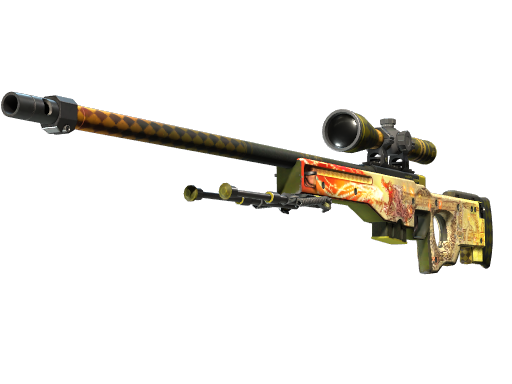
An AWP creates a particular bargain: enormous immediate stopping power in exchange for cost, limited firing speed and vulnerability when opponents coordinate their utility. A great AWPer must manage the second duel as carefully as the first. Where can he retreat? Who covers the gap? Does taking another shot protect the site or merely satisfy the desire for another kill?
This is a useful lens for watching ZywOo, rather than a claim that every round follows a fixed formula. Look for the relationship between his position and the next useful piece of information. A shot can reveal a presence, force utility or make an opponent abandon a route. Those consequences can matter even when no second kill follows.
His relevance also cannot be reduced to rounds with a scope. Counter-Strike forces stars to operate with rifles, pistols and imperfect purchases. When assessing a hybrid threat, ask whether the player still contributes when the preferred weapon is unavailable. That question is much more revealing than assuming an AWP kill total explains a player’s complete value.
Paris 2023: the home Major becomes a statement
At the final CS:GO Major, in Paris, ZywOo won his first Major title and the event’s MVP award. HLTV’s contemporary MVP report recorded a 1.39 Rating 2.0 across the tournament and identified 1.20 as his lowest map rating. Those are event-specific figures under the rating system used in that report, not numbers to compare mechanically with newer formulas.
The important point is the breadth of that performance. One spectacular final can dominate the public memory of a tournament. A floor that high across the event tells a different story: an opponent could not reasonably plan around the expectation that the star would simply disappear for a map.
Still, an MVP does not erase the work around him. A trophy requires five players to manage information, spacing, economy and pressure together. Paris should be remembered as the moment exceptional individual performance and the team’s competitive objective aligned, rather than as proof that four teammates were interchangeable. Winning validates a successful run; it does not turn team Counter-Strike into a solo sport.
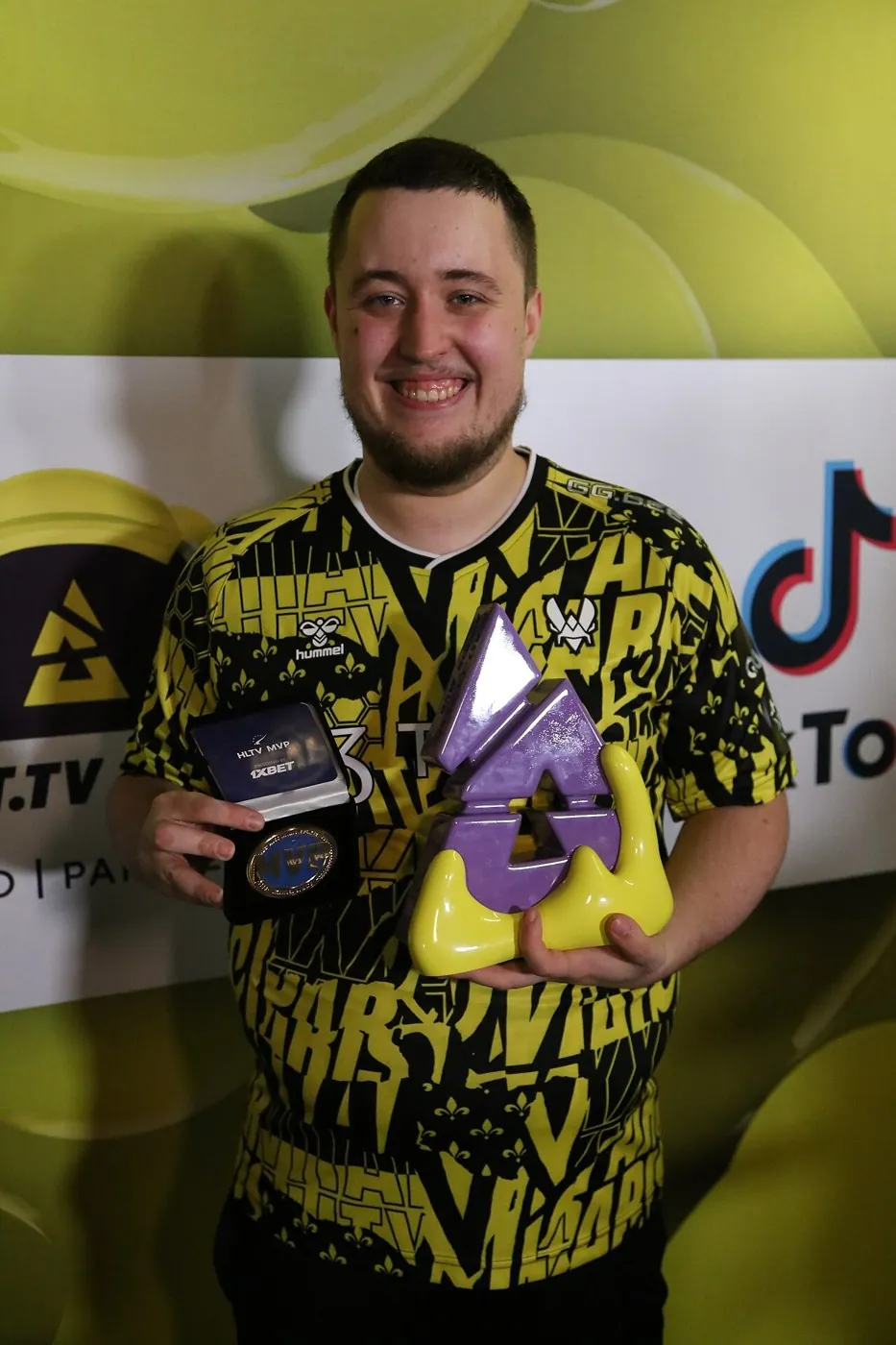
ZywOo with the BLAST Paris Major trophy and MVP medal, May 2023. Archive photograph, resized. VaKarM.net · Original image · CC BY 2.0 · Resized and compressed for publication.
Why the players around him matter
Vitality’s international rebuild in 2022 brought in dupreeh, Magisk and coach zonic. Another significant change arrived with ropz at the beginning of 2025. These are not interchangeable background details: ZywOo’s career crossed different combinations of experience, communication and responsibility. An enduring star still has to work within an evolving team.
An in-game leader’s work is often least visible when a star’s duel looks easiest. A useful flash, a credible threat elsewhere and a teammate holding an escape route can transform the fight before the observer switches cameras. The final shot remains difficult, but its difficulty is not independent of the team’s preparation.
For a ZywOo profile, apEX therefore belongs in the discussion of value. The leader has to allocate risk across the lineup: when to let the star investigate, when to keep him available for a later fight, and when the round demands action from someone else. This is an analysis of the leadership problem, not a reconstruction of an unheard voice channel.
The same principle applies to coaches and riflers. Good structure should create multiple ways to win, so that an opponent cannot spend every resource solving one player. A star becomes more dangerous when respecting him exposes you to someone else. Conversely, blaming him for every team defeat mistakes individual responsibility for complete control over the game.
Cologne 2024: read beyond the 3–1 score
Vitality’s victory over NAVI at IEM Cologne 2024 lasted 117 rounds despite ending in four maps. Nuke finished 16–14, Mirage 22–20, and Vitality ultimately won the series 3–1. The scoreboard is a reminder that a comfortable-looking series margin can conceal repeated rounds on the edge of reversal.
This is the kind of match a long-form profile should preserve. Overtime changes the spectator’s sense of certainty: a lead can vanish, and a single lost advantage can feel like a verdict on the whole final. The analytical task is to separate that emotional experience from the quality of the next decision.
When revisiting the series, examine what happens after a failed round, not only after a multi-kill. Does the next setup expose the same weakness? Is utility being saved for a later threat? Does a player continue to take a justified fight even after losing the previous one? These are questions for replay study, not unsupported claims that one particular adjustment explains every overtime win.
Austin and Budapest: winning does not mean being untouchable
In Austin in June 2025, Vitality lost the opening map of the final to The MongolZ 5–13, then won Dust2 13–4 and Inferno 13–6. They also lost their opening match of the event to Legacy. The eventual title, their seventh consecutive tournament victory, did not require a flawless path.
That sequence is a useful antidote to retrospective mythology. Once a favourite lifts the trophy, its earlier danger can be edited out of the story. Keeping those losses in view makes the achievement more intelligible: the team had to recover from actual competitive problems rather than simply fulfil a prediction.
The year’s second Major supplied another significant result: Vitality defeated FaZe 3–1 in Budapest to win consecutive Majors. These two titles belong to a team accomplishment as well as ZywOo’s career. Our interpretation is that they strengthen a discussion of sustained championship relevance; they do not prove that he dominated every map or that his teammates were secondary figures.
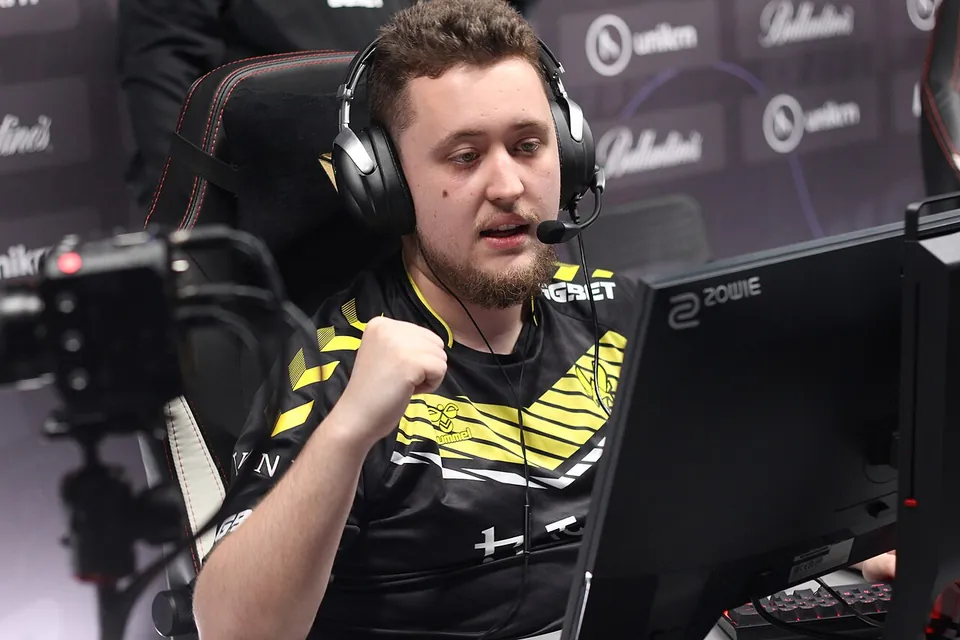
ZywOo at the BLAST Paris Major European RMR in April 2023. Archive photograph, resized. VaKarM.net · Original image · CC BY 2.0 · Resized and compressed for publication.
How opponents can make a great player look ordinary
There is no magic anti-ZywOo tactic, and we are not presenting a statistical scouting report. But the underlying Counter-Strike problem is clear. An opponent wants to deny clean information, make the AWP reposition, and ensure that the first casualty can be traded immediately. A disconnected second attacker gives the defender time to solve another isolated fight.
Economy matters too. A saved weapon can preserve a threat into a later round; an expensive loss can restrict the options available next time. The same kill count can therefore describe very different contributions. Two opening kills against a full purchase and two late exit kills should not automatically be treated as equivalent evidence.
For viewers, the best habit is to pause before the shot. Identify what each side actually knows. Then examine the available alternatives. A missed shot can follow a sound decision; a successful gamble can conceal a poor one. Evaluating only the outcome makes analysis vulnerable to exactly the highlights that first attracted us to the player.
MGHAMER / THE ROUND, EXPLAINED
What happens around the shot?
Mghamer analytical diagram • not tracking data or an actual map
01INFORMATIONWhich angle is safe?
Separate what is known from what is assumed.
02CONTACTWhere is the exit?
Check cover and the possibility of a trade.
03ADVANTAGEWhat did the round gain?
Space, time or a weapon carried forward.
A framework for watching and discussing decisions, not a fixed playbook or statistical player rating.
ZywOo and s1mple: a rivalry without caricatures
It is tempting to cast one as effortless order and the other as spectacular chaos. That is an attractive headline and an inadequate scouting method. Both careers contain patient rounds, aggressive choices, rifle impact and improbable recoveries. Their public images are not complete descriptions of their playbooks.
A fair comparison begins with a defined question. Are we comparing a single tournament peak, complete seasons, longevity, or achievements with particular teammates? Change the question and the evidence changes. Even numerical comparisons require matching the game version, rating formula, opposition and sample rather than assembling whichever figures support a preferred conclusion.
ZywOo’s strongest historical argument does not need the other player to be diminished. It rests on how often his name returned to the very highest level of individual recognition, and on the championship moments that eventually accompanied it. The debate becomes more interesting when it explains different forms of excellence instead of reducing two complex careers to opposing personality types.
What to watch when the camera finds him
Start one action earlier than the highlight. Watch the crosshair before contact, the available cover after firing and the teammate who can trade. Then look one action later: did the advantage become site control, a safer rotation or a weapon carried into the next round? This turns admiration into an understanding of how a round works.
For aspiring players, the transferable lesson is not a promise that copying sensitivity or resolution will reproduce a professional career. It is the habit of asking what a successful action makes possible next. Mechanical practice matters, but mechanics become more useful when the surrounding decisions give them a clear purpose.
ZywOo’s career is extraordinary because its most memorable moments coexist with a long record of elite seasons. The flick belongs in the montage. The repeatable choices around it belong in the explanation. To appreciate him deeply is to keep both in the frame.